

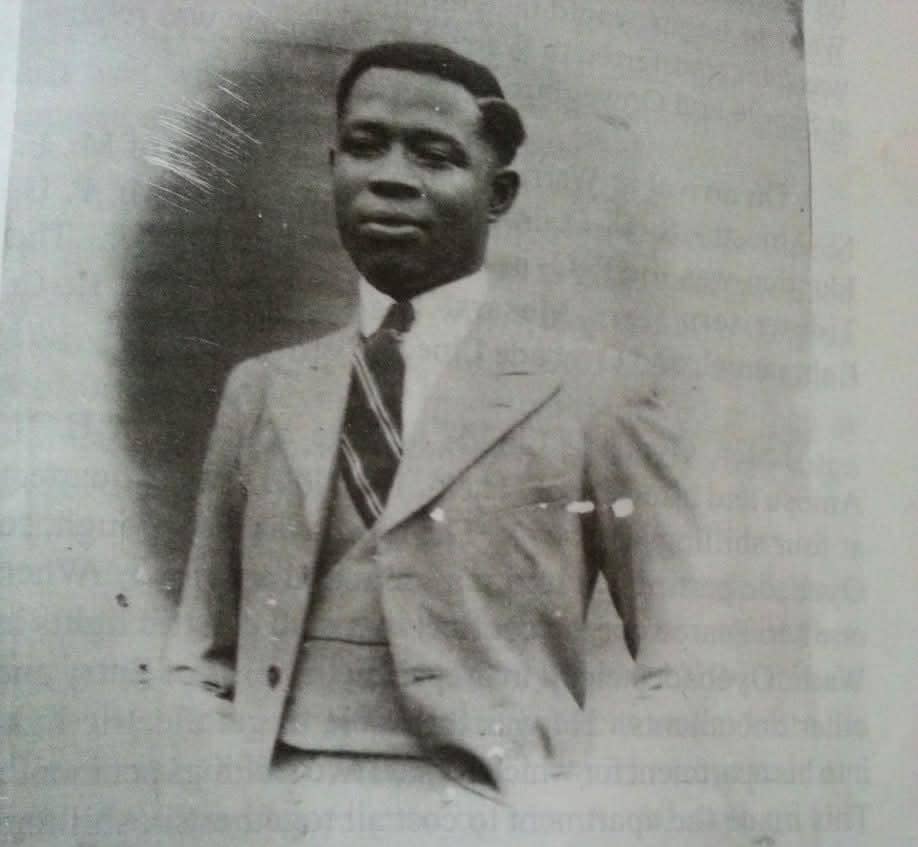
Oba Oyebade Lipede was the ninth Alake of Egbaland, one of the most influential Yoruba traditional stools in southwestern Nigeria. His reign, which lasted from August 1972 until his death in February 2005, remains one of the longest and most consequential in Egba history. Beyond kingship, Lipede was a seasoned civil servant whose administrative experience significantly shaped his leadership style as monarch.
A rare photograph taken in 1941, when he was just 26 years old, captures him as a young officer in the Nigerian Customs Department, years before destiny placed him on the throne of Egbaland.
Birth, Family Background, and Education.
Oba Oyebade Lipede was born on January 26, 1915, in Abeokuta, the heartland of Egbaland in present-day Ogun State. He was born into a royal lineage eligible for the Alake stool, although, like many Egba princes of his era, he pursued a professional career before ascending the throne.
His early education reflected the elite missionary schooling of the period. He attended:
St. Peter’s School, Abeokuta, Abeokuta Grammar School and CMS Grammar School, Lagos.
These institutions were among the most prestigious educational centres in colonial Nigeria and produced many future national leaders.
Civil Service Career Before Kingship
Lipede began his career in 1937, joining the Nigerian Customs Department, where he served diligently for several years. By 1941, the year of the widely circulated photograph, he was already an established customs officer.
He later worked with the Nigerian Produce Marketing Company, gaining further experience in administration, trade regulation, and public service. His years in government service gave him a deep understanding of bureaucracy, negotiation, and governance—skills that would later define his reign as Alake.
Ascension to the Throne
Following the death of his predecessor, Oba Oyebade Lipede was installed as the Alake of Egbaland on August 5, 1972. His coronation marked a new era for Egba traditional leadership at a time when Nigeria was navigating military rule, state creation, and rapid social change.
He reigned for 33 years, making him one of the longest-serving Alakes in history.
Reign and Political Influence
Oba Lipede’s reign coincided with one of the most transformative periods in Nigerian history. One of his most notable achievements was his active lobbying for the creation of Ogun State in 1976.
He played a decisive role in:
Advocating for Abeokuta as the capital of Ogun State
Representing Egba interests during negotiations with the federal military government
Acting as a unifying figure among the Ake, Owu, Gbagura, and Oke-Ona Egba groups
Known for his centrist, diplomatic leadership style, Lipede avoided extreme political alignments and instead focused on consensus-building, cultural preservation, and peaceful coexistence.
Personality and Leadership Style
Oba Oyebade Lipede was widely regarded as:
Calm and methodical
Deeply traditional yet politically pragmatic
A bridge-builder among rival factions within Egbaland
His civil service background strongly influenced his approach to kingship, emphasizing order, consultation, and institutional continuity.
Death and Age
Oba Oyebade Lipede passed away in February 2005 at the age of 90, bringing to an end a reign that had spanned over three decades. His death marked the close of a significant chapter in Egba traditional history.
Legacy
Today, Oba Oyebade Lipede is remembered as:
A stabilising monarch during decades of national uncertainty
A key traditional figure in the creation and consolidation of Ogun State
One of the longest-reigning Alakes of Egbaland
A ruler who successfully blended modern governance experience with ancient Yoruba kingship
His legacy continues to influence traditional leadership and political identity in Egbaland.
Akinjogbin, I. A., The Egba and Their Neighbours
Ogun State Government historical records on state creation (1976)
Daily Times of Nigeria archival reports on Egba traditional institutions
Abeokuta Palace historical records

