

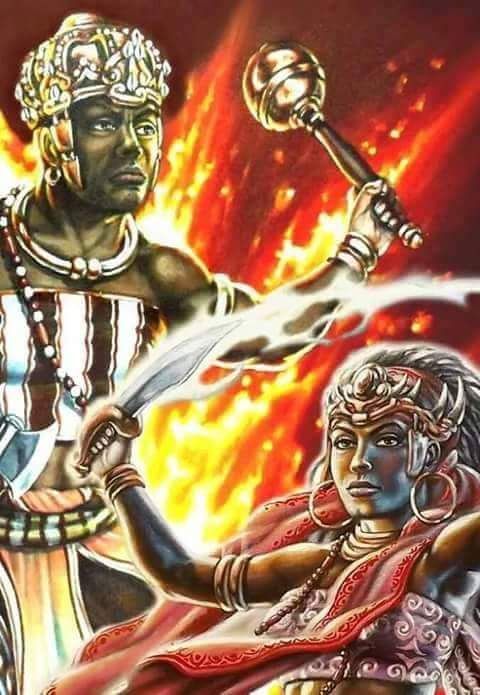
The statement, “You cannot talk about Oya without mentioning Sango; and you cannot talk about Sango without talking about Oya,” captures one of the most enduring relationships in Yoruba cosmology, history, and oral tradition.
OYA OYO – The Alaafin Festival 2026: A Cultural Perspective
In the ancient capital of Oyo, the names Oya and Sango are inseparable. While Sango is revered as the deified Alaafin of the old Oyo Empire and the Orisa of thunder, lightning, justice, and power, Oya is remembered as his formidable consort, the Orisa of winds, storms, transformation, and the gateway between life and the ancestral realm. Their stories have been preserved through chants, oral traditions, festivals, praise poetry, and ritual observances for centuries.
Why Sango is First Appeased
Reports from the 2026 Egungun-Oya celebrations in Oyo indicate that rites connected with Sango preceded other ceremonial activities. This follows a longstanding cultural understanding in Oyo that Sango occupies a central place within the spiritual and historical identity of the kingdom. The Alaafin institution itself traces an important part of its cultural memory to Sango, who is regarded as the third Alaafin and later deified as an Orisa.
In traditional thought, honouring Sango before major rites is not merely religious observance; it is also recognition of Oyo’s historical heritage and royal ancestry.
Oya and the Egungun Connection
Oya occupies a unique position within Yoruba spirituality because she is associated not only with powerful winds and change but also with the passage between the living and the ancestral world. This association naturally connects her to Egungun traditions, where the ancestors are celebrated, invoked, and honoured.
Thus, an Egungun-Oya Festival is more than entertainment. It is a symbolic meeting of:
Ancestors and descendants,
History and contemporary society,
Royal heritage and communal identity,
Spiritual memory and cultural continuity.
Culture at Its Best
The continued observance of Oya and Sango festivals demonstrates the resilience of Yoruba civilization. In an era of globalization and rapid cultural change, these festivals remain living classrooms where younger generations learn history, language, music, drumming, costume traditions, praise poetry, and communal values.
The recognition of the Sango Festival, Oyo on UNESCO’s Representative List of the Intangible Cultural Heritage of Humanity in 2023 further confirms its significance beyond Nigeria and highlights Oyo’s contribution to world cultural heritage.
For Oyo people and indeed all Yoruba descendants worldwide, the celebration is a reminder that culture is not merely inherited; it must be actively preserved, celebrated, and transmitted.
As the drums sound in Oyo and the masquerades emerge, one truth remains evident:
*Oya and Sango are not merely names in mythology; they are enduring symbols of power, identity, ancestry, and the cultural soul of Oyo.*

